Class Theory: Barbarian Concepts
Choosing a class typically is more about its capabilities: what will it allow the character to do? What role can it help you fill such as damage dealer, healer, controller, protector, etc. Is it martial or spell-based? And so on. But when building your character, theorycrafting on why the character, versus the player, followed that path can play a large role in creating an interesting back story. Their Background and Species selections can help towards this, and having an idea of the subclass path they will follow can give you the most clarity, but there still can be different reasons for different characters. Some classes are more straightforward, like a Fighter or Cleric, while some are more open-ended like a Paladin or Warlock. In these Class Theory features we will explore and present concepts to help illustrate the reason a character follows a class path.
In this feature we will explore what gives the Barbarian primal powered rage versus just being a frenzied warrior.
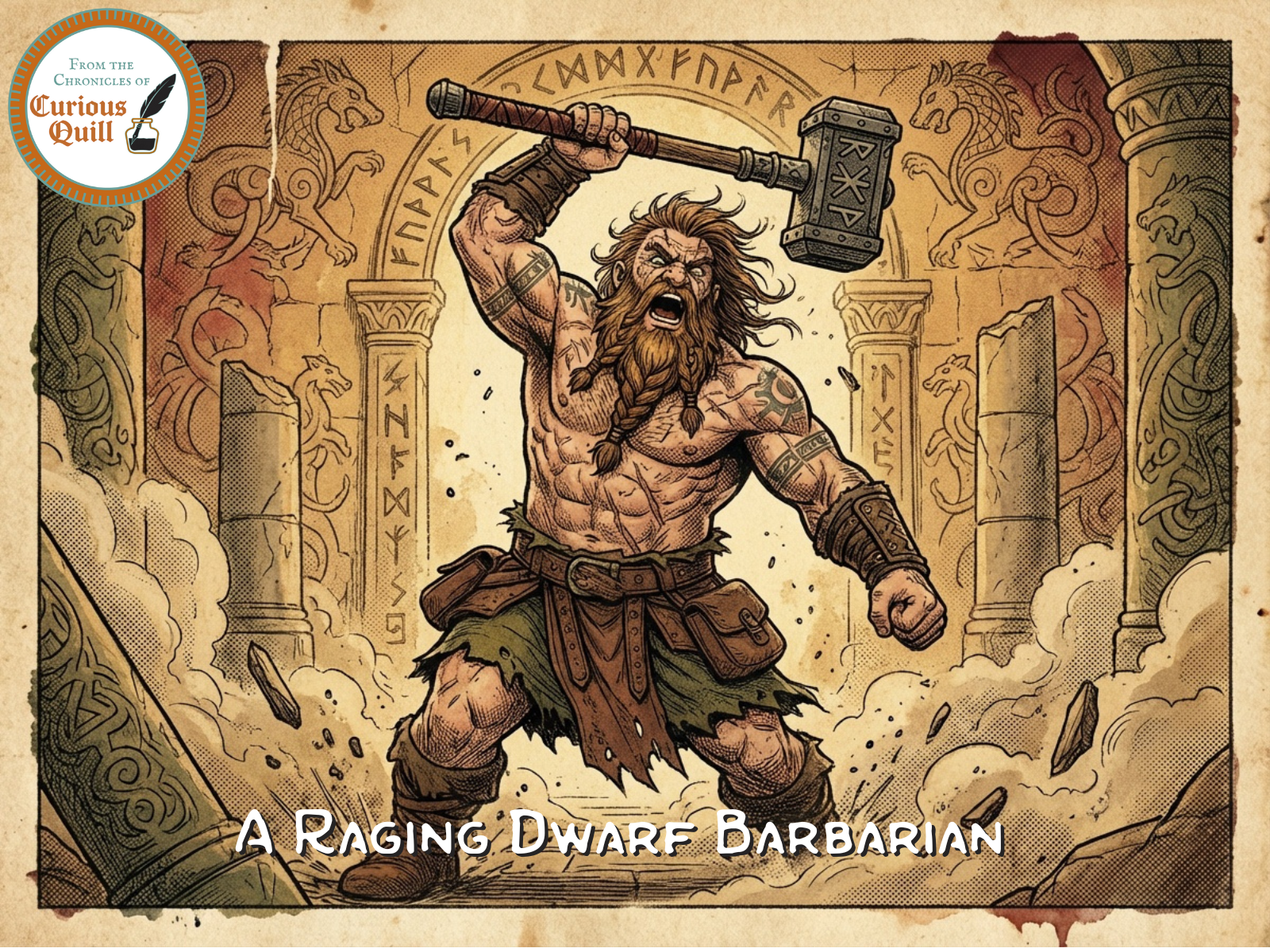
We have been pairing up class concepts but similar features or inspiration such as Clerics and Paladins and then Clerics to Druids. Here we follow Druids with Barbarians. Rangers will be next as they share primal power with the Druid as well, but though Druids and Rangers share similar primal spells, and both are protectors of nature, in many ways Barbarians may be more in tune with the Druid than Rangers. Though Barbarians cannot cast spells, their rage abilities granted by subclasses can be seen as cousins to the Druid’s Wild Shape powers. They literally embody primal forces more than the Ranger.
The intro text for the Barbarian class reads: they are “mighty warriors who are powered by primal forces of the multiverse that manifest t as Rage.” Where does that power come from? What separates them from other warriors who may channel passion and fury into non-primal attacks?
Tumultuous Questions
Druids and Barbarians (as well as Rangers) are considered primal classes, and they obviously are very different thematically separated by magical vs. martial classes. Rangers are marital, and Clerics can take a more martial path through the Protector Divine Order, but Barbarians are unique in eschewing magic (well, at least casting spells) and manifesting primal powers through Rage. Many warriors become frenzied in battle, evoking fury and passion, but most do not have the more dynamic power of the Barbarian’s Rage.
Wild Spirit
Barbarians are able to manifest Rage, but as the PH states this capital-R Rage is “More than a mere emotion—and not limited to anger.” It is an incarnation of primal forces like the storm and sea and the spirit of beasts. The Rage is not only why or where it comes from, but its effects as well: it can manifest as violence, ecstasy, violence, even protection. The subclass will define what how the Rage manifests, but not necessarily the reason. So where did they gain this Rage, the wild spirit that fills their soul?
Ancestral - many Barbarians are one in a line of family members and people who have manifested Rage.
Societal - in many societies, groups of warriors are known to share in frenzied fighting techniques including Raging.
Calling - something, someone, may cause the Rage to arise within them. A spirit may instill them with the might—a primordial spirit such as a beast spirit, the world tree, or even a celestial or divine spirit.
Furor
How do they manifest the Rage, what allows them to become frenzied, what is the cause of their furor? Though the class does not say they need to do anything other than call upon it, it can be fun and helpful to come up with a method that the character uses to manifest their Rage,
Consumable - some Barbarians are know to consume substances that induce their Rage from magical mushrooms, to a specific beverage.
Trance - for some, they step outside themselves—or something enters them— taking over their emotions and fueling their Rage.
Emotion - the character may just have a depth of one or more emotions that they call upon to induce a Rage: anger, yes but also devotion, fear (often for others), and even possibly love.